Accumulation
A spoonful of anything, every day, adds up.

One day in the cold silence of the Covid Era, splayed physically across the bed, sucked psychologically into some empty social media feed through which arced the collective wail of humanity in the throes of its sudden terrifying illness—its electric fear transformed into a thick sludge of sizzling anger, full of bile and petulant spleen, signifying fuck-all—in a sudden fit of self-awareness, I installed DuoLingo on my phone.
I know. For a lot of people, putting that name into a sentence is like saying, “tell me you’re shallow without telling me you’re shallow.” I get it. Learning a language with DuoLingo is like going swimming with water wings. It’s the round-ended scissors of language learning. Yeah yeah yeah. But you know what’s worse than using DuoLingo to learn a language? Twitter. X. Whatever the fuck.
It’s silly but the thing that hooked me was the relentless pursuit of the streak—the ever-increasing count of successive days upon which you took a step, if even just a tiny one, forward. In the manner befitting the Silicon Valley capitalist set, money is always a buffer against self-acknowledgement, and with the careful application of the green stuff one can patch holes in one’s streak. But I wasn’t interested in that. Watching the number climb, legitimately, tickled my lizard brain in a spot that hadn’t yet been cauterized by the likes of Elon Musk.
It took until fairly recently for me to fully acknowledge the value of daily habits over the bursts of enthusiasm that have typically been the basis of my achievements throughout my first half-century. If it couldn’t be done in a single 16-hour session fueled by soda and candy, it likely wasn’t going to get finished. Ever.
Then about 14 years ago I planned and somehow managed to execute a 2,000 mile bike trip down the Great River Road, alongside the Mississippi River. This was something I definitely couldn’t do in one go, but once you’ve bought the plane ticket and you’ve spent an entire day pedaling through rural Minnesota, what choice do you have? I had to stop, had to sleep, and the next morning I had to get up and do it again, lest my denuded skeleton should remain as a warning to other travelers on the Paul Bunyan Bike Trail. Every day I’d put another 70 miles onto the total, and that total rose and rose—140, 210, 280. It was almost surprising to see how the numbers stacked up, and when I reached 1,000, the rest felt almost downhill.1 Just knowing that I would inexorably reach my goal if I kept it knocking out those relatively short daily rides.2 And I did.
The Duolingo streak became my odometer for language learning, and since then I’ve begun tracking all sorts of daily habits. I have lists all over the place. Stacks of four-by-six note cards. I make graphs. Like a goddamn crazy person.
I’m not gonna start waving numbers around like an Olympic judge though. Suffice it to say I’ve been doing a lot of things with great consistency for several years now. Above all, language things. And as it’s been almost a year and a half of such consistency since I last said anything on this subject, I shall celebrate by pretending that you, dear reader, have been ardently clamoring for an update.
Beginning with the coldly quantitative, I haven’t taken the official Goethe-Zentrum test, but I took a placement test whilst considering enrolling in a German certificate course, and placed at C1.3 That’s the fifth of six ranks, and that was at least a year ago. My capabilities are a little uneven though: My reading is much better than either my writing or listening, and my writing and listening are better than my speaking. Be that as it may, whatever the difficulties in the details, I can communicate clearly and efficiently and expressively with German speakers. I can confidently call myself bilingual. It’s fucking nuts.
I know my speaking would be better if I had more opportunities to practice. There are classes and private lessons but that shit is expensive and there’s not much point in honing a skill I can’t use outside of a classroom. I don’t ignore it (ask my family) but I don’t prioritize it.
Reading is another matter. You don’t need to be in a German-speaking country to buy and read German books. Plenty of bookstores carry them and of course you can order practically anything short of human meat4 on the Internet. I can practice immersion learning in print, easy-peasy.
To that end, I’ve been plugging away at a series of novels by the German author Volker Kutscher. As I’ve noted previously, these are the novels that are the basis for the Netflix series Babylon Berlin, though the deeper into the series I get, the less it resembles that show. The only consistent factor really are the names of the characters.
Which is fine. The show is decent, but the books are simply smashing. Every one of them is a bestseller in Germany, and for good reason. Ostensibly they are detective novels, and this is indeed their form. And quite good detective novels they are. What the full series does, however, is to give the reader a ground eye view of the rise of the Third Reich. It’s really interesting reading this stuff in German, 80 years after the end of the war. At least chronologically, Kutscher is to Germany as William Faulkner is to the United States and the Civil War. I don’t think Kutscher set out to revolutionize German literature, so it’s probably an unfair comparison, but he’s really a splendid writer and his portrayal of his country’s worst moments is pretty much unblinking and deeply moving.
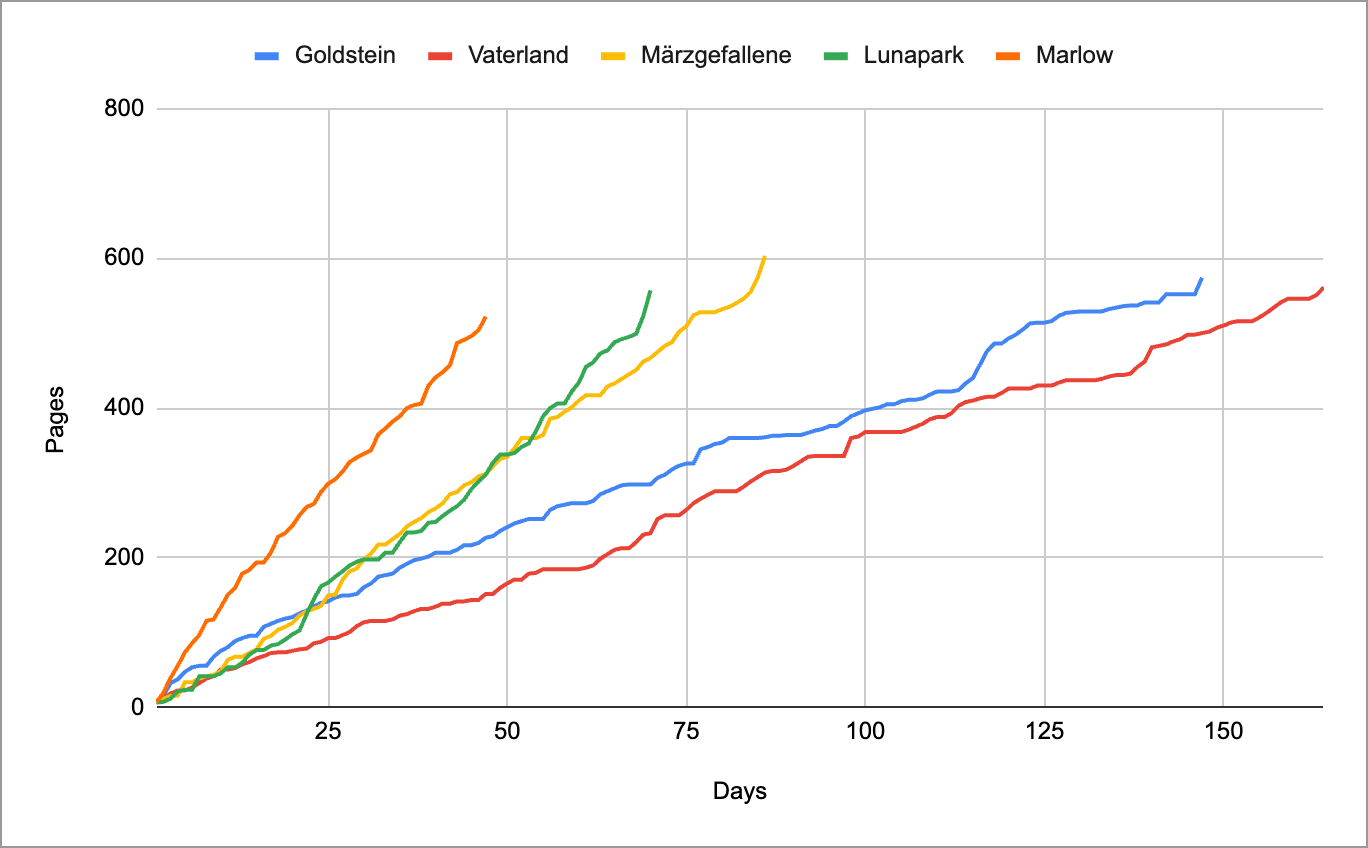
There are days, especially in our own current political environment, where it’s almost too much. But putting aside the content, I can’t think about these books without feeling pride over my accomplishment here, which has been substantial. 4,200 pages I’ve put away. After three and a half years, I’ve reached the end of the seventh book. The first took me 14 months. The most recent one I finished in 43 days. At the pace I’m going, I’ll reach the end by September, four years after I began.
I have charts and graphs to prove it.

Also, because I was riding south. Which, as we all know, is down.
70 miles is not really a short ride, especially when you’re doing it day after day. But it’s shorter than 2,000.
“Can understand a wide range of demanding, longer clauses and recognize implicit meaning. Can express ideas fluently and spontaneously without much obvious searching for expressions. Can use language flexibly and effectively for social, academic and professional purposes. Can produce clear, well-structured, detailed text on complex subjects, showing controlled use of organisational patterns, connectors and cohesive devices.”
The jokes make themselves, so you make your own.